by Cynthia Tinapple on September 29, 2006 · 2 comments
PCDaily is not about promoting products (note to self). Voice, authenticity, daring, quirkiness…that's what we hunt for in polymer clay art. And one way to express yourself clearly is by making your own tools, textures, stamps and transfers.
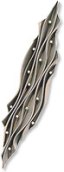
Victoria James' silicon plates look like the results of long walks in the woods. If yesterday's textures piqued your interest, be sure to check out today's links to Victoria's plates for sale along with ideas for making your own. She'll be demoing her techniques at the San Diego guild's Sandy Camp next week. We hope the group will send us some pictures (hint, hint).
Fall in Ohio is just full of color and texture. I hope you can get outside and soak in all the beauty this weekend.
by Cynthia Tinapple on September 28, 2006 · 2 comments
Speaking of guild sites, you should probably take a look at the Southern Ontario Guild's site too. There's some very good work in the gallery – like these spiral topped containers from Margi Laurin. (The guild's server is a bit sluggish so try again later if it kicks you off. The links below work fine.)
And you're a link away from another treasure of that guild. Member Helen Breil's texture plates are now available from Canadian supplier, Shades of Clay.
Helen's first shipment of these quirky and touchable textures sold out quickly. She's bulked up her inventory so that you can confidently order them.
For the DIYers, note that at the bottom of the texture sheet page Helen offers an 8-page "Creating Your Own Texture Sheets" booklet.
by Cynthia Tinapple on September 27, 2006 · 5 comments
by Cynthia Tinapple on September 26, 2006 · 0 comments
Paula Pindroh from Lakewood, Ohio, joins the ranks of polymer clay illustrators (see the new category in the right hand column).
Artists like Meredith Dittmar, Doreen Gay-Kassel, Sylvie Perrin, Marcia Rocha and others take the clay in a direction that few of us pursue and many of us admire. Most of these illustrators started out working on paper and were lured to polymer because of its three dimensional possibilities and the immediacy of its color.
Thanks to Susan Rose for the link.