Phthalates – Tempest in a teapot?

What energetic and informative conversations we’ve started about the safety of polymer clay. Is this holiday tension or pent-up anxiety about the future of our craft? Or as Lea Hernandez describes it, "…a wave of Booga! Booga! Booga!" Nan Roche suggests that perhaps it’s a tempest in a teapot (teapots courtesy of Karyn Kozak).

Most of you have pointed out that few artists’ materials are without risks if handled improperly. Here are a few excerpts from your emails. Thanks for all the wise comments…and wisecracks.

Judy Belcher says

I also wondered, do those galleries burn lovely yankee candles to make the store smell for the holiday or maybe spritz a little victoria’s secret room spray? Yep, you guessed it, phthalate in the fragrance oils.

Lindly Haunani asks

What happened to all the people who were getting brain tumors from using portable phones?

Nan Roche weighs in

What I tell my students about phthalates is this. Any medical procedure you have involving tubing, saline or blood bags etc are delivering astonishingly high amounts of phthalates directly into your bloodstream. It is excreted in your urine and feces.

Medicine has been using plastics for delivery of vital fluids for over 60 years now. If there was any obvious toxicity from this it would have surfaced by now. Without the use of these plasticizers to soften the tubing and bags used, delivery of safe, sterile and shippable fluids for medical use would have been severely hampered.

Over the past 60 years, average life spans have increased remarkably in part because of some of these advances in medicine. I think this is a tempest in a teapot in that, short of total global catastrophe, we will never abandon this technology. It’s just too practical and important for our modern way of living.
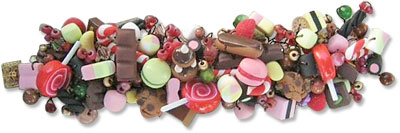
Polymer Clay Safety – Weigh the facts

This sweets bracelet looks good enough to eat…but don’t. It’s polymer clay from France’s Cristalline.

On her Artpreneur blog Judy Dunn provides a clear, cogent article about the fears surrounding polymer clay. Putting her degree in chemistry to good use, Judy takes a logical, scientific approach to the subject.

The same gallery owner who suggests that it would be good to avoid purchasing a polymer clay necklace because of the risks that phthalates pose, carries jewelry made with resin, enamel, and other "toxic" materials in her gallery.

When the customer buys any of these finished products, they are chemically stable and safe, just as a polymer clay necklace would be. But the artists are exposed to potential toxins in the creation of the work. Used intelligently, the risks are manageable with all these materials. There is no real risk to the consumer with any of them. If we want to eliminate risks, let’s do it judiciously, and with consideration of the facts.

Arm yourself with more facts by reading Judy’s entire post. Thanks to Rachel Carren for pointing out the article.

If you’re really into recycling, Lindly Haunani suggests you remember to put organ donation on your list. Recycle yourself!

Polymer Clay Miniature Feast

It’s time to start thinking about Thanksgiving dinner and this 1/12th size polymer clay feast from Norway’s Christel Jensen makes it look easy. Check out the bananas in her fruit tarts. And her bread dough looks absolutely edible.

Christel has a new DVD out if you’d like to learn to make miniature teapots. Don’t miss her detailed flowers and inviting room settings.

Susan Lomuto reminds us that the 2008 polymer clay Niche Award finalists have been named and there are statements from each of the finalists on the NPCG site. The pictures of the entries are frustratingly miniature. Congrats to the finalists.

I’m off to grocery shop and tidy the house for guests. And of course there’s the OSU/Michigan game. Go Bucks.

Polymer Clay and Ephemera

I had to smile at the bevy of polymer clay beauties that arrived in Tuesday’s email…among them these vintage spice tin women and light bulb ladies.

Israel’s Naama Zamir builds sculptures over discarded lightbulbs and each character comes with her own story. Ohio’s Diana Cundall has a penchant for spice cans with personalities and she collages ephemera onto polymer clay pendants.

You may want to revisit some former PCD recycling favorites as well – Barbara Lang, Dayle Doroshow and Jean Comport come to mind. Keep those suggestions coming in. Thanks to Susan Lomuto for the spice can link.

Polymer Clay Recycles


With the big move toward eco-friendly products, polymer clay artists are once again apologizing for their plastic material. Let’s not be too quick to abandon our craft. Polymer clay is nothing if not adaptable…and we must be too.

We’re experts at recycling! We cover and reclaim tins and glassware. We combine polymer with fibers and found materials. We alter and reuse books.

I’ll be searching out artists who move with, rather than against, the tide of public sentiment and ecological sensitivities.

These recent assemblages from California’s Dotty McMillan illustrate the point. (I love the titles, "Too Much Time on Her Hands" and "Life Has You Nailed Down.") Here’s a recent interview with Dotty.

Mertz’ New Work

Online photo galleries give us the added benefit of tracking how a polymer clay artist’s work is developing. I was startled by the changes in Austria’s Bettina Mertz’ work.

Her June class with Sarah Shriver must have struck a chord and her work became much more detailed and controlled. Next she shows crocheted beads where again she takes to the technique with ease.

Bettina’s combination of new skills are helping her find her voice that shines through her new pieces. Her "blackberry" beads are crocheted combinations of polymer and seed beads that look just like their name. Her polymer clay sand beads are shown here. Her earlier work is shown on her guild’s site here.

Wilfrid Wood Works

England’s Wilfrid Wood sculpts 4" to 12" polymer clay interpretations of people, animals and creatures from his own personal perspective. His pieces may make you laugh or squirm or blush. Part caricature, part fantasy, their unflinching honesty is sure to elicit a response and as Wood says, "…they’re straight from the heart." He talks about his work here.

Wood starts with a pencil drawing then makes a wire armature which he covers with polymer clay. He paints and varnishes the baked clay. Some characters are duplicated in vinyl editions.

Thanks to Susan Lomuto for getting us off to a thought-provoking start this week.

Zilliacus Tapestries

Maryland’s Carol Zilliacus has been a pioneer in polymer clay. Early on, she replicated tapestries, needlework and fabric in clay, cutting and reassembling sheets of clay in unusual ways. Then she began incorporating watercolor and painting techniques into her polymer works.

I still refer to Carol’s article “New Ways to Think About Polymer Clay” that appeared in the April 2001 issue of Bead and Button. She was one of the first artists to play around with Skinner blends, adding colors and shapes in surprising ways. And she continues to play.

Carol’s teaching a class November 18 at Artway and has a video available through the store. Have a playful weekend.

Chandler’s West Coast Muses

Canada’s Gera Scott Chandler is getting ready for her holiday shows with a bevy of new polymer clay beauties. You can follow along and pick up some great tips (check out her unusual vessel price tag design).

She’s about to unveil the redesign of her booth.

For a closer look at Gera’s work, visit her Flickr site. It’s filled with the west coast seaside muses that inspire her.

Cookie Cutter Canes

It’s turning cold. Nearly time for snowflakes. As a kid I loved folding and cutting paper to reveal an endless variety of snowflake patterns.

Sandy from Canada is having a grand time doing the same thing in polymer clay with a simple cane pattern she’s developed. She calls it "cookie cutter caning." I found this post on her site in August.

After a class with Marla Frankenburg in September, Sandy started creating her flakes in translucent clay. This almost makes winter look like fun.