Angeli Sobrepena from the Philippines rekindled her childhood interest in cross-stitch by integrating it with polymer! She creates her design, leaves holes for stitching with embroidery floss, and bakes the clay.
It looks like Angeli finishes her pieces with a backing of felt to hide the thread on the back (or the backing could be an oval of polymer that she rebakes).
These make cute crossover projects for our embroidering friends who have a hard time putting down the needle! Find more of Angeli’s work on Flickr.
Ryan MacLeod is a self-taught polymer sculptor who sets his dragons down in the midst of the most unlikely and mischievous predicaments – from candy store to steampunk. His ornate miniature polymer piano was irrestible. American-born Ryan now lives in India with his wife and family.
His friendly dragons, like this recent Fire Dragon, will charm and delight you with his antics. This is a good way to warm up to the goblins and dark creatures that will be visiting PCD soon in honor of Halloween.
Perhaps the easiest way to appreciate all Ryan’s dense and complex creations is on Pinterest. You may also catch up with him on his website and on Facebook.
Susan Lomuto (Daily Art Muse) sent this link along. See what mischief she’s been up to with her new MAM and sample a free issue here.
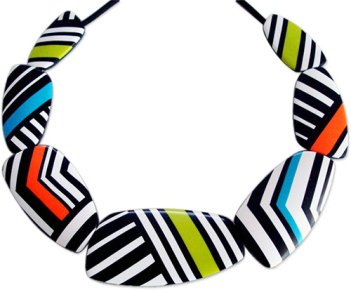
Over a cup of coffee Slovenia’s Renata happened upon the inspiration for this graphic, eye-popping polymer necklace.
For her birthday Renata had requested a set of the Illy coffee mugs designed by Tobias Rehberger. Once she had the cups she felt compelled to make a companion polymer necklace. More pieces may follow.
Genevieve Williamson and her family were dropped off on a remote island in the South Atlantic for the summer (check out Saint Helena) and she’s recently returned to her rural Pennsylvania home. Her father installed a new skylight in her attic studio while she was away that may make you jealous.
Genevieve has taken the dust covers off her work table as she dives into work for a gallery show. Already you can see that her months of a simpler life have changed her approach to clay. These simple strands of tubing in subtle shades, shifting diameters and slim palettes may hint at what’s to come.
She’s also added some variations to her earring project that was featured in Polymer Clay Global Perspectives. Has your summer changed your work?
The footed boxes are heartfelt tokens made as gifts for family members. Small, humble artworks can still strike a chord in the hearts of online fans. Thousands were amazed at what could be done with polymer. The link came to PCDaily from Society of American Mosaic Artists trustee Sharon Plummer.
These convex discs from Page McNall are two sides of a pendent she was creating from a blended sheet of clay. Even though she doesn’t show the assembled piece, you can see the possibilities.
Page is working on more 3D pieces saying, “My goal is to make irregularly shaped holes and inscribe intricate designs.” You can see what she’s accomplished on Flickr.
She describes the process, “After I made the blend, I cut the circle and draped it over the copper form where I proceeded to cut the decorative holes and draw patterns. I dusted the entire surface with black embossing powder and cured it. After it cooled, I used 600 grit sandpaper while the clay was still on the copper form and added Renaissance wax to give a subtle shine.” Follow along on her step-by-step here.
Barcelona’s Sona Grigoryan offers much more than this handful of Manuscript Beads on her Flickr site. For these ethnic beads Sona transfers flowing text and historic Armenian images to clay and forms the beads from strips torn from the flat sheets of transfers.
Lately she’s been constructing hollow organic beads and wrapping them with fiber or fiber-like vines and pods. She even tries macrame in polymer.
You can watch her work move from beads to sculpture to fiber and then to a combination of all three. She’s not finished with her experiments so we’ll visit often. Here she is on Facebook.
Carol Simmons and Rebecca Watkins are sharing the fruits of their recent collaborative work with you!
Carol wanted to experiment with big polymer beads and Rebecca wanted them lightweight and textured. Rebecca came up with an ingenious solution to make them hollow. Paper!
Since paper’s burning point is 451° Fahrenheit, it works as an armature for polymer. Rebecca researched and redrew various shape templates, printed them onto cardstock, cut them out, and taped each shape together. The constructed forms were covered with a thin layer of polymer (see the black forms in this picture) and baked.
Carol and Rebecca covered the baked forms with slices of kaleidoscope canes. Rebecca incised deep lines into Carol’s densely patterned canes. They tried a variety of methods – deeply or lightly textured, highlighted with dark powder (see Rebecca’s project in Polymer Clay Global Perspectives) or not, covered in sheets of pattern or with small sections. Each test bead was then rebaked.
Here are her shape files for you to download free, print and play with. “They are free because I did not invent geometry!” says Rebecca. Still, it was generous of the duo to share their secrets. Thanks to them we have another great way to create hollow forms with polymer.
Amy Christie is a maker and a mom. She offers a quick free tutorial on how to transfer kids art to polymer, add magnets and make what I think of as a refrigerator shrine.
Darling doodles and sweet scribbles deserve to be kept as a reminder of innocence and pure play.
When I said that my grandson’s drawings looked like Willem de Kooning’s work, my daughter-in-law rightly said that the reverse was true. De Kooning worked hard to recapture the grace of children’s brushstrokes, color and composition. We’re all trying to get back to our unaffected, free selves.
Inspired by scenes from the video game, Animal Crossing: New Leaf, this mostly polymer sculpture from Tucson’s Camille Young stands 5″ x 15″.
The piece, entitled Cross Section, was created for the Fangamer X Attract Mode show in Seattle. Video gamers love seeing their 2D characters brought to life in 3D by Camille and her sculpture represents a kind of modern shrine.
The Animal Crossing game allows players to build their own happy places and make the decisions that shape their lives.
These concepts may be completely foreign to us non-gamers but the audience for this artwork is huge and growing. Read about Camille in Polymer Clay Global Perspectives to get a glimpse of how and why this art is so important. She offers a 3D project for you to try.
Camille’s been sidetracked by her 6-month old daughter and it’s great to see her working (after Iris is in bed) again. Sample more of her work on Flickr and Facebook.