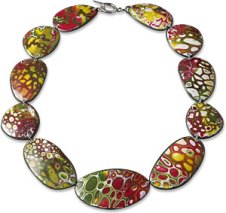
The organizers of the Philadelphia Museum of Art Craft Show have invited Scotland to be the Guest Country for the November show.
Melanie Muir vows to bring whiskey and shortbread with her polymer creations if she’s chosen to be among the 25 Scottish makers.
The pebbles necklace on the left is one of her entries for the show. It was inspired by the rocks she runs by on Nairn beach each morning. You can see more of her latest works on her updated site.
No matter what the colors, Melanie’s beads give one the sensation of looking down through the rocky coastal waters outside her Scottish highlands studio.
Dee Wilder (Malodora) and Matilde Colas show pictures of their inspirations and allow us to follow the paths to their final interpretations.
For most polymer artists, the ability to convert an inspiring palette of colors into polymer is what draws them to the medium. These two do it with style.
Dee discovered her colors in a fabric swatch and accurately mimicked the batik’s layers of colors on her beads.
Matilde was attracted by a photo of flowers that she turned into a juicy assortment of colors. She cut out gently curving pieces and stacked them to make pins and pendants.
Staying alert for color inspiration is the trick (and the fun).
These Ford/Forlano polymer beads were bought by collector Daphne Farago in 1999. She gave her collection to the Museum of Fine Arts Boston in 2006 and the Big Beads appear in the new book, Jewelry by Artists.
The Big Bead series is still ongoing and both Dave and Steve create them, giving each bead character yet working toward a unified design. Steve says, “Dave’s beads play with opaque and translucent cane slices to add depth to the surface, while my beads are always opaque and very graphic, emphasizing a variety of textures contrasting baked and re-baked clay layers.”
These early necklaces were all-polymer. Steve adds, “The clasp is a screw-type brass clasp, covered in clay, with a technique that Pier Voulkos used and taught. The beads are formed over an aluminum foil core, another ingenious Voulkos innovation.”
Ford/Forlano have also posted a stunning picture of their latest Hydro-Top pins in which patterns in the formed metal (by metalsmith Maryanne Petrus) are repeated and expanded in polymer.
The closeup of Wanda Shums’ latest lamp experiment may make you rethink transparent polymer clay! A turtle rests on the top of a translucent water lily and dragonflies float in pools of blue light.
At the end of a successful show season Wanda was nearly burned out by production work. She treated herself to some play time, creating for her own pleasure to feed her spirit and recharge her batteries.
She pulled out translucent canes she built last spring and gave them new life on a glass lamp globe. Then she added some sculptural elements. Giving herself permission to play resulted in a flood of creativity.
Portland’s Gesine Kratzner been sculpting squiggly polymer creatures for as long as she can remember.
If you’re feeling scared and tentative about your own work, take a look at the bio of this talented illustrator and see how she’s turned silly squiggles into an impressive career.
Gesine’s been an an animation professional for 18 years, lending her design sense to ad campaigns, short films, sculptures and paintings and exhibiting her work in galleries in Oregon and California. She has an Etsy shop, Blobhouse, as well.
Thanks for Randee Ketzel for introducing us to this polymer artist.
You can move from “same old, same old” to “tada” by selecting something that tickles your fancy from a huge array of classes and workshops.
The growing list includes everything from free at-home courses (check out this free lesson from Donna Kato) to intensive retreats at exotic locations (consider the new Polymer Pamper Play on the Isle of Portland, Dorset), to guild retreats (fantasize about Florida’s Fandango).
Eighteen top teachers will conduct studio classes at Cabin Fever in Maryland in late February! Judith Skinner will be awarded the 2011 Creative Pioneer and Innovator Award at the event.
Maureen Carlson has unveiled a new lineup of polymer and mixed media instructors in her annual schedule. Her Center for Creative Arts is a cozy, intimate space near Minneapolis that’s perfect for brewing big ideas.
A number of polymer classes are tucked in the sprawling Tucson Bead Show in February. Then in June, the Bead & Button show lists these projects.
If you need to stay close to home, CraftEdu has just added a whole bunch of new offerings on their site.
This is just the tip of the polymer iceberg! PolymerClayWorkshops and the international guild provide free listings for events all over the globe – from online to out-of-this-world. Start exploring and you’ll come up with something that fits your desires and your pocketbook.
UK’s Claire Wallis offers a “tada!” of her own with this knitted polymer cuff bracelet. She says that faux knitting was an experiment which she shares in a short visual tutorial on Flickr. My eyes had a hard time believing what I was seeing.
Claire used light cream colored polymer to keep the focus on texture in this piece. Imagine the possibilities that colored “yarn” would add.
I’d forgotten what a relief it is to bring an idea to life.Tada! See my “in progress” shots here.
Joining the TADA365 project has kept me in the studio and off the computer. I’m getting ahead but falling behind!
I’m happy to show you the results of my first efforts, a heart bangle covered with extruded triangle slices. It’s a design that’s been rolling around in my head ever since I saw Melanie West demonstrate the method she developed for her bio-bangles.
The twinkle of the glitter in the “special effects” Premo that’s mixed in some of the colors doesn’t show in the photographs. It gives the piece subtle glitz. I was introduced to glitter clay by a five-year-old friend and love how Dayle Doroshow mixes it sparingly in her work.
Holland’s north coast has inspired Linda Ezerman to translate her beachcombing with polymer and felt. Smooth links, faceted chunks and flat pebbles are joined with felted wool into a wild wearable beach.
The carving and felting and lost wax techniques
that Linda shows on her exciting Flickr pages promise to take us polymer rock hounds in new directions.
If something has taken a bite out of your New Year’s resolve and you’re feeling snarky this Monday, allow yourself a few minutes to read Christi Friesen’s latest enewletter.
Pick up a free inspirational poster or read through a tutorial. There are lots of toys and distractions on her site. She knows how to throw a polymer party that will pick up your spirits in no time.