It’s time to catch up with the newest versions of Stroppel and Retro cane tutorial possibilities. Just when you thought these cane formulas had been explored thoroughly, Page McNall stretches her scrap into striped tubes, Antonina Lyamaeva from Germany wraps her retros into multicolored swirls while Linda Wentink extrudes hers in flat strips that look very Klimt-like. It pays to keep asking, “What if?”
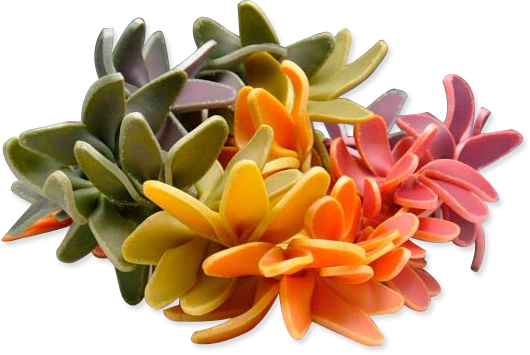
Canada’s Claire Maunsell worked in hot glass for twenty years and she reflexively handles polymer as if it were hot and liquid. These beautiful hollow pods are created using a technique that Claire explains in the upcoming Global Perspectives book which is full of new names, exciting concepts and scads of pictures.
Artists who crossover from glass, textiles, ceramics and sculpture are perhaps the most exciting part of our global story.
While you wait (the book arrives in July), enjoy Claire’s rough yet sophisticated glass-meets-polymer work on her Etsy shop (where she’s busy adding items), her Zibbet shop, her blog and her Flickr pages.
Turkey’s Alev Gozonar tied together large pixelated polymer portraits of Marilyn Monroe, Che Guevara, Virigina Woolf, Frida Kahlo and other VIPs pairing them with renderings of VOPs – that’s very ordinary people – for her Way exhibit at Mabeyn Gallery in Istanbul last year.
Here you see Alev with her Sahne IV piece that combines thousands of lengths of extruded cane into a striking 49″ x 40″ image. Polymer QR codes designed into the portraits offered viewers another way to interact with the works.
Visit the gallery site and read the news coverage to comprehend the scale and impact of these unusual mosaics. There’s a weekend worth of research here that may make you rethink scale and size.
Bali’s Jon Anderson has been slow to warm to the social network scene and just launched a new website and Facebook fan page. Hop right on over there to greet this prolific polymer artist and make him feel at home online.
You’ll recognize Jon’s richly cane-covered animal sculptures which are carried widely in US gallerys and have ended up in the collections of such notables as Carlos Santana, Dave Abbruzzese, and Bill Clinton.
Jon creates massive complex canes inspired by Moroccan images and limits his colors to his favorite palette.Though we’re familiar with Jon’s work, his reclusive nature has made him something of a mystery in the polymer community. (You may remember his custom guitar designs from an earlier PCD post.)
We’ve been waiting since last fall when Canadian polymer artist and textile expert Barb Alexander scheduled a tour of Jon’s studio for her group of Bali visitors. Jon and his wife, artist Skid More, were working then to prepare the site.
This copper bowl, made from scrap copper telephone wire hammered by local artisans and covered with Jon’s signature cane slices, is part of his most recent collection. Browse and enjoy.
A slice of polymer cane artfully draped over a swinging silver loop makes a particularly breezy summer earring. The pointed elliptical shape reminds us of blooming petals.
White popped up today so let’s run with it. Barcelona’s Sona Grigoryan disregarded the color in Gaudi’s architecture and concentrated on the famous architect’s shapes that she interpreted into a polymer cuff.
Wendy Malinow took the color out of flowers and bones and applied them as a background on the platform of some summer sandals she’s working on.
Sometimes you can disregard color, focus on form instead and end up somewhere entirely new.
These pendants-in-process by Meisha Barbee begged to be photographed at the end of the conference. Right next to them a few new earrings waited to be assembled.
The angled cuts on the earrings may give you a clue that Meisha had watched Jana Roberts Benzon demonstrate her laser cut technique. But with Meisha’s distinctive color sense and handling of elements, the Benzon-like pieces retained Meisha’s vibe. What a great example of integrating a technique and sharing without simply copying!
Ron Lehocky boosted his tally of polymer hearts past the 23,000 mark this week, creating popular designs from scrap canes destashed from other artists’ studios as well as his own creations. At $10 per heart, you can calculate how much Ron has raised for the Kids Center in Louisville Kentucky. Click on the picture for a closer look.
Ron talks about how the consistent size of the heart-sized canvas has allowed him to focus on technique and explore design within the limits of the brooches’ scale. After beveling 23,000 hearts, he can undercut an edge with remarkable speed and precision. His finishing techniques are superb.
Ron’s putting together a class on Ronnie Gane, a variation he’s developed that reveals spirals and geometric shapes. He plans to teach his method when his schedule allows.
In this StudioMojo video Ron talks about how the heart project began and why creating something tangible has been so important to him. See previous posts on his progress here.
Vermont’s Meta Strick combines bits of wood, wire, beads and yarn on her art dolls. Then she dresses them in polymer. Often they carry inspirational messages. There are mixed media shrines, dolls, sculpture, buttons and more under construction here in Virginia. We’re not limited to jewelry.
Meta (rhymes with pita) is also a painter (see more here). An unexpected gift of Genesis heat-set paints prompted her to try painting on polymer this week. Turn this ragged-edged slab of polymer over and you’ll find a portrait that looks like an ancient relic. Painting on polymer could offer you a diversion next time you’re feeling exasperated with jewelry-making.
Lindly Haunani is working on a new tropical bracelet that uses her signature juicy colors with new shapes and ingredients. The edges of the petals pop with slightly lighter shades and texture variations.
Even as I watch her work, her way of creating seamless gradations baffles me. She checks and rechecks her colors before putting them into the long multi-color canes that she needs for production (see her test strips). It’s hard to keep my eyes on my own work surface when these colors are exploding at the next table.