Control to Chaos

Former NPCG president,

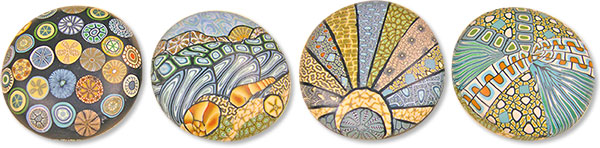
Carol Simmons has figured out how to bring control to the chaos of polymer clay kaleidoscope canes. These samples were all generated from one base cane.

Just as Judith Skinner saw polymer clay color gradations as a math problem to be solved, Carol has seen kaleidoscope canes as a system to be reassembled and explained. A scientist and researcher, Carol took a methodical approach to the problem and came up with an elegant solution.

Obviously this is more than science, however. It takes artistry and a fine sense of color to come up with these powerful combinations.

Thanks to her for sharing her new discovery. We’ll have to wait to hear how Carol decides to publish or teach her new technique.

And this seasonal polymer clay treat is from Illinois’ Scott Mizevitz, a multiple winner and now a judge in the "Bottles of Hope Challenge." Enjoy his photos and have a lovely Easter weekend.

Chaos and Control

Colorado’s Shane Smith creates and combines kaleodoscopic in a slightly different way shown here. You can see some additional samples.

I think of Sarah Shriver as the mother of this technique (not so sure she’d like that designation) and she has a DVD on the technique that’s not to be missed.

Then there’s Jana Roberts Benzon who wraps and bends the slices into 3-D constructions. And Karen Lewis (Klew) and many more. Each of these artists works in a slightly different way with distinctive results.

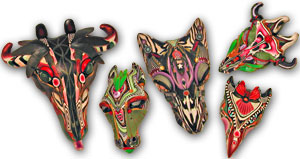
At one gathering there were so many artists who build these intricate canes that constructing objects with the cane slices became a team sport resulting in fantasy creatures like the ones shown here.

Delft-like

Oregon’s Dede Leupold doesn’t google well and I have only these pictures for you to enjoy today…no links to chase. I wish I could show you more of her fine polymer clay kaleidoscopic canes.

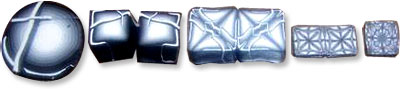
Dede’s precision, her colors (mostly blues) and her fine silver work combine into the most amazing delicate pieces. She often works in blue and white Delft colors and makes beautiful buttons.

These kaleidoscope caners are a reclusive bunch. Come back tomorrow to see who I’ve been able to roust.

Mandalas

To Colorado artist Yuriy Luzov, reality consists primarily of geometry and music. With this in mind, he began to study symmetry and fractal patterns, replicating kaleidoscope and mandala patterns in translucent polymer clay. Yuriy lists M.C. Escher among his favorite artists and it’s easy to see why.

If you’re overwhelmed by his deviant art site, check out the presentation he gave to the Pikes Peak guild. The pictures explain the process more clearly than words can.

There are several kaleidoscope cane experts in our midst that we’ll revisit this week.

Sculpted Florals


Some polymer clay floral morsels for your Monday morning from Barbara Fajardo’s blog. You’ll have to scroll to the bottom of her page to see this New Mexican artist’s newest works. She says she got a bit carried away with the paint.

We’re seeing a nice revival of 3-D designs with surprising textures and delightful twists.

Barbara has also published her "rules to live by" in her polymer clay life. It’s worth reading. Her commercial site is located here.

Bolder Works

Another look at Turkish artist Alev Gözonar’s new works can invigorate us this Friday. She takes a bold, self-possessed approach to polymer clay in her art. It’s helpful for those of us who take a smaller, more self conscious view of our craft (myself included) to see this display. Sometimes it takes another culture’s perspective to shake our preconceived notions.

Alev says, "I want to make art that is new and accessible in order to reach a wider public." Have a bold weekend.

Off the Hook

NPCG show coordinator Diane Villano responded to yesterday’s concern about the web publishing of works that might be entered in the Progress and Possibilities show. Says show coordinator Diane, "Previously published means in print format, i.e., magazine, book, etc. Images mounted on web sites are perfectly okay to submit to the exhibit."

Regatta

Regatta is what Julie Picarello has named this luscious piece that’s among the designs she’s working on for submission to NPCG’s Progress and Possibilities show. The colors really sing and she manages to incorporate her signature watch parts into the necklace.

She’s fleshed out her web site and added a page of works in progress. You’ll want to take a second look.

You have a couple more days to get your entry into the NPCG show. Go online for the paperwork and have another look at the new NPCG site. There’s a terrific article on Robert Dancik by Marcia Laska with an accompanying hollow bead trick.

Spring Training

Yes, these are polymer clay canes so detailed that it seems impossible. Since 1991, Wes Warren from Edmonton, Alberta, Canada, has been perfecting his caning technique and making his living from his well-developed skills.

Many of his beads are built on sports or team imagery. His word canes are incredibly precise.

You can see a sampling of his beads on his Flickr page and read his fascinating life story on his ebay site.

I picked up this Canadian inspiration by way of Israel from Iris Mishly’s blog, Polymeri Online. You’ll want to check out her finds often so I’ve added a link to her in the sidebar.