Kentucky’s Ron Lehocky brings us a turkey heart for the U.S. Thanksgiving holiday today. This Thanksgiving marks the fifth anniversary of the heart project.
Ron has made and sold 14,000 polymer clay heart pins to benefit the Kids Center for Pediatric Therapies. Can you imagine making 14,000 hearts in your spare time?
PCD has followed Ron on this project. Read earlier posts here and here. We can be thankful for artists like Ron who put their talents to such good use. He’s gearing up for Christmas and you can email him for a heart here.
I’m thankful for all you loyal PCDers and wish you a Happy Thanksgiving.
I’ve been on a bit of an electroforming jag lately. Here’s a new link from Tavostia in Russia and some experimenting from Cynthia Blanton.
For those of you who, like me, are trying to resist the urge to impulsively invest in more equipment, I’ve come up with a faux electroforming trick that may help.
First I made silicone molds of some bumpy unidentified berries from a neighbor’s tree and cast white polymer beads from the molds and fired them. Then I pulled out my alcohol inks, colored the white clay and let the inks dry.
To give the berry beads a metallic/electroformed look, I pulled out my secret weapon – gilder’s paste! Sue Sutherland and Ellen Prophater let us try theirs at a conference and I was hooked. The paste reminds me of the old-fashioned shoe polish that comes in flat cans. A swipe of a paste-coated finger over the top of a design highlights it with a metallic sheen which becomes permanent in a few hours. Gilders paste can be moved around or wiped off in the first few minutes which I find a big benefit over Rub and Buff or paint.
Copper-colored highlights would have passed for electroforming so I’m adding that to my supply. Sue and Ellen are building their site over at Filigree and More and you can email them to order.
As Genevieve says, “I’ve had some polymer artists extend themselves and share their knowledge and present me with great opportunities. Kindness should overflow, shouldn’t it? So it seems appropriate that I make my first small attempt to give back with a tutorial at the beginning of America’s week of Thanksgiving.”
The kindness flowed back from Germany in the watery colors of Kathrin Neumaier’s fish bead necklace. Kathrin acknowledges that her idea for carving the fish beads came after seeing the rough hewn look of Genevieve’s carved beads and rings. The link was sent in by Margit Böhmer.
There is much caring and sharing in this community and yesterday was an example of your goodness. See Monday’s post if you missed all the ruckus and the happy ending. As Angela Mabray said, “Now that that’s settled, let’s all get back to work.”
Many polymer clay colorists and teachers are concerned about Polyform Products’ announcement that the company is changing its Premo color palette. While I prefer to avoid manufacturing topics, this is one where several dear friends who could be impacted have asked PCD to get the word out in hopes of making a difference.
Please read and then add your voice to the matter. We’d like to urge the company to rethink its decision. Some relevant links are listed below.
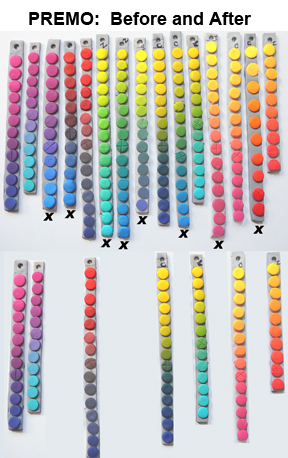
Among Polyform’s changes, two primary colors, essential for color blending and teaching color theory will be eliminated from the Premo line. Zinc yellow and cobalt blue, essential for most of the primary blends shown here, will no longer be available.
An x below a strand in the top row of Premo blended samples indicates an affected color. The bottom row shows the remaining colors. Thanks to Carol Simmons for the illustration.
If you’ve ever seen the meticulous, laborious processes that polymer colorists and teachers go through to develop their theories and formulas, you can understand their distress. Fine artists who rely on signature colors for their livelihood, will be forced to undergo costly reformulations.
We applaud Polyform’s appeal to the hobby market whose vitality improves the future of our craft. At the same time, we appeal to the company consider the needs of the artists who have supported them and who continue to expand the use of Polyform products and make the brand visible to a wide audience through fine art, education, and research.
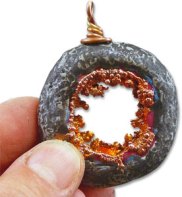
Watching Dee Wilder, Ann Davis (that’s her bangle) and others (see the previous links) experiment with electroforming on polymer satisfies my urge to jump right in and try it…for now, at least. Go see what they’re up to.
Loose ends
As I clean up my desk for Friday I note that Raija Korpela has kindly shared her crinkle cut technique with a picture tutorial. It’s an easy, fun distraction for weekend playing.Thanks, Raija.
Madrid’s Silvia Ortiz de la Torre makes bright colored “nidos” (which translates as nests) out of polymer. Circles of blended colors connected with buna cord form web of rings. Polymer balls hook them together and secure the ends.
The whole nest is so playful that it gets me thinking about how this construction could be used elsewhere. Wouldn’t this make a great mobile? Lately all ideas lead me back to babies. Did I introduce you to my grandson Oliver who got his name and his domain on the same day? Each time you refresh his page, you’ll get a new picture.
Kerstin Rupprecht has perfected these extruded spirals. The edges of her clay cracks to reveal stunning contrasts. Blends flow from light to dark. What looks like a happy accident is no accident at all. Kerstin calls polymer her therapy and you can sense the meditative quality of her spirals. Though she has a website, she admits that it’s much easier to keep pictures current on her Flickr pages.
Kerstin is a special ed teacher near Frankfurt, Germany. “For me polymer clay is a passion but not a profession,” she explains. “I don’t sell my work – most of the time I give it as a gift to those I love or just keep it for myself.”
She started the first German group at Yahoo which later became the guild (polyclaykunst.de). The contributions of those who are “passionate but not professional” is what has kept our community growing. Randee Ketzel tipped us off to this one.
Oxana Volkova’s photo shoot fascinates me! Her glamour and over-the-top chunky polymer, felt and knit creations make me clap and smile. And the matching makeup makes me wonder if I have those eye shadow colors in my bathroom.
While she was waiting for the professional photographer to show up, Oxana started snapping some behind the scenes shots. They give us a peek at how this Moscow artist works.
If you’re feeling uptight or bored with your work, a few minutes with her Flickr site will freshen your perspective.
Donna Greenberg has been a textile and ceramic artist and muralist for years. Seven months ago she was introduced to polymer clay and she hasn’t looked back. I particularly like the way her drawings and illustrations spill over into her polymer jewelry work.
These bangles are part of her Craters, Meteorites and Moons series. If you check her Facebook fan page you’ll see her latest springy thingy craze. The enthusiasm and energy of a newcomer is just what we need for Monday.
Donna sent me the link to her new site…hint, hint.
Sandra McCaw’s work launches us to the east coast. Two of her entries are finalists in the Niche Awards. These earrings have been named in the Fashion Jewelry category and one of her signature necklaces was selected in the Polymer Clay group. Both pieces showcase her ability, “…to create complex patterns where lines seem to lose their distinction and blend, and where colors bloom and merge.”
And speaking of the holidays, Dayle Doroshow and I have put together an inspirational volume that’s chock full of Dayle’s famous tricks for easing you back into the studio when your muse goes missing. Creative Sparks is full of luscious pictures and powerful tips. Preview and purchase it here.