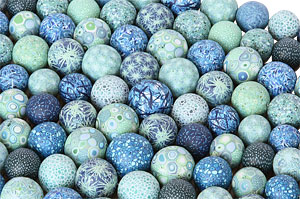
Sarah Shriver has added big polymer shapes, a bit of metal and new palettes (her Frida colors) to her repertoire. She calls the series pictured here her acorn beads. She’ll be teaching how to make these new big beads, veneer beads built over ultra-light clay, at CFCF in February.
Clicking across the images on her site’s front page makes me want more, more and bigger pictures. And it makes me wish I were on the west coast in December when she sells and parties up and down the coast. If you’re in the area, put one of her events on your calendar.
Finnish polymer clay artist, Raija Korpela (Turha Luulo) has me stumped. I’m not entirely sure how she achieves that crinkle cut french fry texture on her beads but I like it.
I’m guessing that she wraps strips of wavy-blade-cut polymer on a bead core. Check out her experiments on her Flickr page. Raija likes to fool the eye. Here’s an earlier post about her.
I have a new grandchild, our first! We’ll have to Skype a look at our grandson for the first few weeks until we can head west for a visit.
What better time to remind you to look at Camille Allen’s marvelous new polymer micro babies? Her tiny lifelike infants have attracted an amazing following of swooning grandmothers and serious collectors. Camille lives in British Columbia and eight years ago learned to sculpt dolls in polymer from her grandmother. Her miniatures range from $99 for a resin copy to $5,000 for a polymer original. I’m captivated, of course.
Ditzy moves
In my anxiety I overlooked several details last week. Judy Summers should have been listed in the Niche finalists. One of her horses is in the running! And I meant to include Vickie Hallmark in the list of electroforming experimenters.
A link from Kathy Weaver pushed me to look at Russian sites which give us an idea of how polymer art is progressing in that country. This requires clicking through annoying ads and garbled translations but it’s worth the effort.
The trendy colors and hip clothes in the photos on Julia Laukhina’s site could have been from a craft fair in any urban center. Julli-Ya is from Moscow and this batch of soothing colors launches us calmly into a new week.
Then I ran into Elkozzzavra also from Moscow who loves her Dremel. She enthusiastically drills and carves polymer. It works and she’s developed techniques that look like a good outlet for aggression and result in gem-like sculptured art.
Check out her swiss cheese trees and positive/negative butterfly. Luckily she adds a photo tutorial with her carved pumpkin pin.
Have you gotten wind of the electroforming on polymer craze? A glance at the kit available from Sherri Haab and a look at the recent experiments of these artists may start your wheels spinning:
That led me to some of the glass folks like Kate Fowle Meleney who’ve become expert at electroforming.
If you know of others who are experimenting, send me links to their work. For those of you who prefer more low tech polymer, check out this easy and fun free bead shaping tutorial.
My eye can usually spot polymer at 50 paces and when it can’t, I’m delighted. Which is why Claire Maunsell’s latest batch of beads thrills me. There’s a fluidity that may come from her years working with glass. This polymer looks like something more.
Claire added bits of image transfer leftovers to her hollow beads, brushed on some new metallic paints, played with translucent clay, stippled surfaces and drew with inks. It’s her layering of colors and methods and messages that fools the eye and builds up a wonderful story.
Claire also shares her process in ways that I can understand. She reveals that, “Sometime ago I bought a set of metallic paints to use with polymer, but every time I tried them the result was so disappointingly garish that I would throw all the results away and curse my inability to resist temptation in art supply stores.” Who hasn’t been there?
She thoroughly describes her thought processes, her missteps and her techniques on her blog. I like going to her Flickr pages to get an overview of her results. What an inspiration.
Carol Simmons has tiptoed into blogging and you can follow along as she rolls out her new polymer cane slicer. It’s a serious machine that certainly does the trick.
Carol is also unveiling new work with this Sporocarps piece. After years of looking at mosses, lichens and algae under the microscope, she reinterpreted her vision in polymer.
She’s also published a new Flickr site which gives you a quick view of how her botanically-based art has grown.
More Niche Award toots have been heard. This piece from San Diego’s Meisha Barbee’s Shimmer series was selected as a finalist. Meisha has started incorporating sterling silver elements into her polymer clay pieces. See previous PCD posts about Meisha here and here.
Liz Hall sent in the link to her silver and polymer Bubbles Belt Buckle that qualified as a finalist. A jellyfish swims among bubbles in this mixed media piece.
The 2011 Niche Award finalists have been selected and I snagged these three polymer artists who have been notified that they’re in the running. I’m assuming there are more finalists out there but I couldn’t find an official list. Mousing through the work of these three should launch your week while we wait for other finalists to toot their horns.
Thanks to a new Flickr link from Bettina Welker, you’ll rediscover a wealth of recent work from this Prague artist. Eva’s canes are simple but sumptuous and dense with pattern. It’s probably not surprising to learn that she teaches pottery lessons for children.
I was afraid that Halloween eye candy wouldn’t sustain you through the weekend but Eva’s online store will surely keep you charged up. Sweet!