Artists

Spring strings

The UK’s Susan Rimmer led me off track as I was searching for more inscribed beads to show you. Susan has an intriguing way of quickly making a tried and true technique her own.

These pendants covered with extruded polymer strings look like modern sea urchins and demonstrate how she tweaks our expectations. Her site is full of similar twists and turns.

I found Susan from Carol Simmons’ Finding Inspiration post. Carol’s Flickr favorites are a gold mine for color lovers.

Polymer relic style

Take a look at the new batch of work posted by California’s Selena Wells if you’re in the mood for more polymer that’s been written on and roughed up. That seems to be the theme that’s emerging this week. This ancient-looking pendant is actually a cyber-tribal piece entitled “Broadcast.” In the same vein, she posted a relic that’s a polymer-covered USB drive.

Selena often adds more intrigue to her pieces by embedding tiny cabochons into the clay. Here’s her Etsy shop.

Scribed designs

Gera Chandler has packed up her muses and sent them away. After visiting her studio for months they’re off to galleries and Gera’s Etsy shop.

These 12″ willowy wall-mounted polymer sculptures have thick fiber hair and gleaming gowns. Gera etches and scratches designs into her fabric-like polymer much like we saw on Claire Maunsell’s work yesterday.

You can see the whole glowing group on her Flickr pages. Heading for new homes, the muses are sure to inspire and delight.

The Natasha bead evolves

Claire Maunsell’s experiments with polymer Natasha beads provide us with some brain teasers to start the week. (Iris Mishly offers an easy-to-follow .pdf tutorial of the basic Natasha technique here.)

Watching the symmetrical patterns emerge is mesmerizing. Beginners are often introduced to the wonders of polymer this way and the technique can make wonderful use of a scrap pile. But, as Claire points out, it leaves you with a squared off brick.

Claire began by pulling on a Natasha block. Bullet forms appeared. “I started in earnest at this point to etch and scratch away at the emerging and disappearing lines, the remains of the original perfect mirror images,” she says. “Then, the corners of the Natasha ‘brick’ began to move outwards, and the bead to shorten – they became propellers and pods and mostly maintained their symmetry.”

Her results are fascinating and she explains her process in detail. Try it! What can you come up with?

April fools!

Thanks for following along with this April fool all week. Collaboration at the Outer Banks has been exhilarating and exhausting and I highly recommend the process. Find a group that boosts your confidence and stretches your mind.

Leslie Blackford made these necklaces for our group. It was a generous gesture that we will treasure. She knew enough about each of us to make a character that touched on a bit of truth. Can you identify one or two? I’ll publish a key on the weekend.

Please hang on while I get back to your emails in the next few days. I’m off to the hot tub! Have a hot weekend!

Hint

Here’s our silly group picture to help you.

Gossamer gills from translucent polymer

These polymer color chips scattered around Seth Savarick’s work area look like beach glass or Italian ice. They’re what Seth calls his “gossamer gills” and to create shapes he stacks paper-thin multicolor layers of the baked translucent clay.

It’s hard to explain (especially late at night). Here are a few pictures of his collaboration with Robert Dancik who created the metal boat shapes that Seth is filling with his glass-like gills. His almost micro-mosaic technique is alluring. I find myself wondering about the possibility of faux beach glass. Anybody tried?

You can catch up with Seth at Arrowmont this fall where he’ll be teaching the inro techniques he’s most known for.

Smokin’ extrusions

You may find it hard to believe but Sarah Shriver has never extruded polymer. Today I introduced her to the wonders of extrusion with a stainless steel extruder, adaptor and variable speed drill. Sarah shows her delight at her discovery.

She marveled and promptly included her results on one of the beads in the project she and Dayle Doroshow are working on. (Only one side on the bead is covered in this picture.)

You’d be surprised at how many of these polymer experts haven’t experimented with techniques outside their own. This week has provided them with an opportunity to be novices without embarrassing themselves.

Outer Banks, inner limits

It may not look like much but these polymer pebbles (mine) and lichen focal bead (Lindly’s) represent a stretch for both of us and a leap into new territory. Our team experiments may or may not work but we trust each other and egg each other on.

Judy Belcher and Tammy Honaman engineered this week at a sumptuous off-season Outer Banks, North Carolina beach rental as a way to force artists who were comfortable with each other into a situation where they would play and push and tolerate some discomfort.

At the end of the project, after the discards and false starts, some new directions will emerge from the collaborations. They’re hoping that you will be interested in reading their upcoming book about what happens during processes like this.

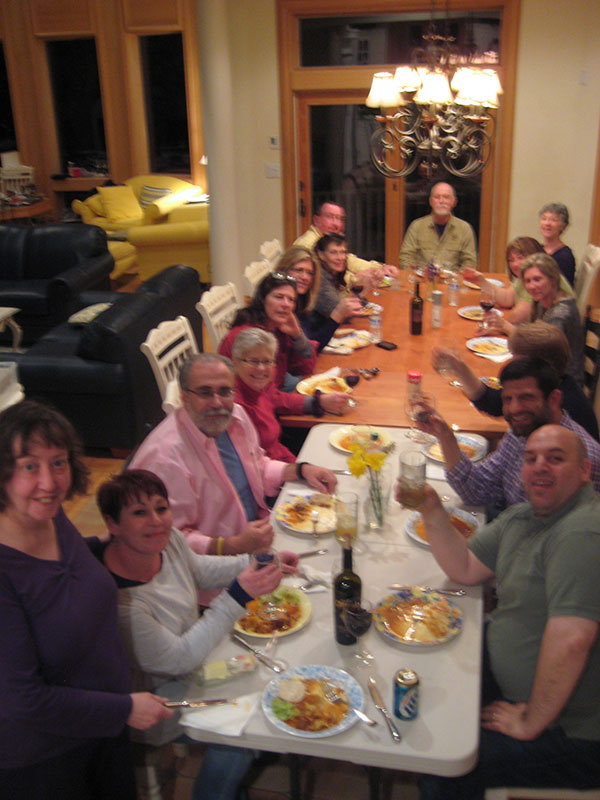
It’s cold and gray outside but we’re warm and colorful. Here’s a toast to you readers from the group at dinner tonight. Thanks for following along. We’ll see what happens.

Moving out of your zone

These cane slice polymer earrings from Sandra McCaw looked lovely on Sandra. Quick pictures taken on a paper plate don’t do them justice but if you go to her site you’ll see more of these beauties.

The five-slice rectangles are bordered by a fine strip of clay topped with gold leaf. The findings are handmade and have the most delicate hammered hooks.

On another note, it’s oddly refreshing to watch this group of polymer clay experts struggle and make rejects and failures as they collaborate in search of new ideas. Amid the piles of not-so-greats, you can spot strange new successes. More about that with pictures as the week progresses.

Telltale polymer

This polymer-covered sugar spoon with its cautionary warning caught my eye at breakfast.

Judy Belcher explained that when Leslie Blackford was a house guest, she stirred her morning coffee with the sugar spoon and returned it to the sugar bowl…in violation of house rules. Judy’s husband brought the breach of etiquette to Leslie’s attention.

To atone for her gaffe, Leslie sent the Belchers a special spoon immortalizing the occasion so that others wouldn’t make the same mistake. It’s a charming, funny story and it certainly is effective.

Do you have polymer art that tells a tale or makes you smile? That can be one of the best uses of our art. More silly stories from the road on Monday. Have a great weekend and mind your manners.