Artists

How to build a design

One of the satisfactions of attending a workshop for polymer artists is watching how others work.

The black marks that Loretta Lam sketched across these beads gave me a clue as to where she was headed with her design. The baked gray base beads are made from blended scrap clay (ultralight and polymer) which she covered with veneers, adding a few sculptural elements and textures.

This week Loretta posted a picture of the final necklace with the juxtaposed lines, patterns and shapes all in place. The mixture of elements forces your eye around the piece and offers something interesting no matter where your focus lands.

You can read more about Loretta’s art and business in this recent interview and on her Facebook fan page. Does this make you rethink your process?
 

Polymer stackers

Wallace stacker beads

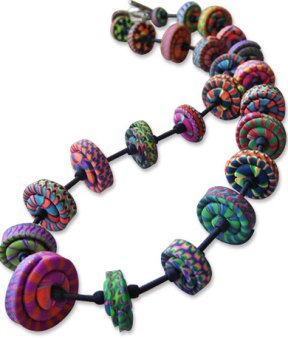
“Stacker beads,” Amy Wallace admits, “are something I could make until the sun blows up.” This Cincinnati artist has been working on spirals since 1995 and offers a how-to tutorial on her Etsy shop. This necklace is one of her bright variations.

“For me, polymer clay isn’t about making the most complicated cane, it’s about creating inventive, spontaneous designs with hints of the past thrown in. Color is my second language,” she says.

Amy mixes seed beeds, fiber, paper, buttons into her art arsenal. Her blog is a good read with a free tutorial tucked in from time to time. Be sure to check out her polymer and seed bead embroidery and her freeform chevron beads on her Facebook page too.

Polymer and Prismacolors

Clarks Prismacolors

Colorado’s Maria Clark shows us how a limited toolbox can force you to dig deep into your creative resources and try something new.

Maria had some time on her hands because she was traveling. She purchased a package of white clay, a small set of colored pencils and a bit of burnt umber and gold metallic paints. Her only other tools were pens, pencils and a crochet hook she’d brought along.

Who knew you could get such deep colors with Prismacolors on polymer? (See Tuesday’s post on Libby Mills to see another example.) Thanks to Marian Hertzog who sent Maria’s link along.

Polymer fountain

Watch the water glide over Leila Bidler’s polymer creation as you consider the possibilities for your own garden. In Leila’s home in Italy the 4″ x 11″ fountain recirculates water that flows out through holes in the flower on the top and trickles down over the sides. Click the video to see it in action.

The housing is made of bronze, copper, brass and black Premo which Leila has textured and sculpted. The aged look comes from a wash of Swellegant copper brass and black patinas topped with Tiffany green and darkening dyes.

A small submersible fountain pump housed inside keeps the water circulating.

Leila introduced this piece on her Facebook page and the conversation continues there. Thanks to Anke Humpert who brought the link to our attention.

Scribbled polymer

Hollow beads are all the rage this year. At last week’s conference my tablemate Libby Mills applied her own distinct style by carving and doodling on the hollow forms with Prismacolor pencils followed by a wash of black acrylic.

She paired the beads with wire wraps that echoed the scribbled look. You may notice that scribbling has been a theme of Libby’s for years. This new design may push her back into the studio to play again.

Polymer quest

Utah’s Cody Craynor has been on a mission. “I’ve basically been on a quest to create the perfect chevron bead. Why settle for sloppy beads?” he asks.

PCD last looked at his faux trade beads three years ago. His methods are mighty close to perfection and I’d like to know what he’s taught himself.

Let’s let Cody know that we’re watching and we’d love to learn from him. He says he’s never shared his methods (or met another polymer artist) but he’s open to the idea.

Polymer shoe-in

Jacqueline Cherie has retrieved her studio from storage and unpacked all the molds she researched and collected.

You’ve probably run across images in books like these that feature her polymer pieces which were meticulously rendered and based on antiquities, pre-Columbian images and Asian icons.

This polymer encrusted shoe, created for a contest several years ago, still stuns. Here’s a box and a small container from her collection.

Welcome Jacqueline back after her three-year breather and expect to see photos of her new works posted soon.

Flipflop buttons

Mari O’Dell offered us sunshine and smiles (and a break from too much seriousness) with her selection of caned and sculpted polymer buttons.

In addition to selling them for sewing onto clothing for fashion accents, Mari ties buttons onto flipflops using waxed linen cord.

Mari’s a big fan of extrusion and most of her 3D elements are made using the dies offered by Polymer Clay Express. Here’s a snapshot of her workspace that’s always adorned with flowers and inspiration.

Lam’s lovelies

Lam bangles

These bangles from Loretta Lam were heaped in a beautiful pile on a table. Loretta’s another artist who’s so busy that she doesn’t often update her web photos and this is our chance to get an update.

While she remains true to her signature patterns and muted palette, lately Loretta’s been applying the polymer pieces to sleek and dramatic bangle forms in a collage style. The finish is as smooth as the design.

Simple solutions

Ann Dillon pulled out a selection of her latest brooches, simple and elegant design solutions in polymer. Slices of extruded cane patterns cut at different heights stand next to each other on top of layered, textured bases cut into loose shapes. What took the most time, Ann admitted, was deciding which extruded circle patterns looked happy beside each other.

Ann doesn’t often refresh the pictures on her site and Facebook so it’s a treat to rifle through her latest works here in Virginia and give you a peek.